Wednesday, April 29, 2020

ROSES I Want

Sweet Briar Rose 

Known as the "Sweet Briar Rose" because of the strongly apple-scented leaves, this is a favorite English native that has been recorded in literature from Chaucer to Shakespeare. R. eglanteria, or 'Eglanteria', has been common in cottage gardens on both sides of the Atlantic because it is not only hardy but always fragrant, whether or not it is in bloom. The rambling shrub is large, thorny, and vigorous with dark green, slightly rough foliage. Spring flowers are pink with five petals and have a good rose fragrance of their own. R. eglanteria should be part of every fragrance garden. Rain, wind and sun all seem to bring out the perfume of the plant. If supported as a climber, it could reach 10 to 15 feet.

Sweet Briar Rose

Old Blush

old rose
Touted to be the rose that inspired the Thomas Moore poem 'Last Rose of Summer' (though some experts dispute that based on the timeline), it is easy to see the reasoning, as this rose is a reliable and continuous bloomer that does continue to bloom into the Dog Days long after others have surrendered to the sweltering heat and humidity.
Old Blush Climbing rose, beautiful, but only for zones 7 - 9

R. X RICHARDII

a gallica rose
Wild Rose
This is the rose that Thomas Christopherson talks about in his book in Search of Lost Roses. It was excavated from a burial ground by Flinders Petrie in the form of a head wreath. It is also called "the Holy Rose of Abyssinia" and was still used in the 1800s in Coptic Christian churchyards. 

Mumiekransrosen - Rosa richardii. photo - Inger Omø Steen-Hansen ...
R. x richardii is known as the 'Holy Rose of Abyssinia', where it ...R. x richardii | Wild Rose | David Austin Roses

Seven Sisters

rambler
  • Both this rose and R. multiflora carnea were painted by Redouté in France and both are frequently found in early Texas gardens. By the effort that it took to transport them through the intervening miles, those early settlers have left their own testimony about the need for beauty in even the most rugged human existence. ‘Seven Sisters’ is named for the variety of colors that can appear in each cluster of flowers, ranging from carmine through purple, mauve, pink, and cream as the flowers fade.
  • Named for the seven shades that can be seen at any one time. Big clusters of double, typical Multiflora flowers, which gradually develop from deep cerise to pale mauve and later ivory white. Strong fruity fragrance. Free-flowering and strong growing. 1815.
Seven Sisters


Sunday, April 26, 2020

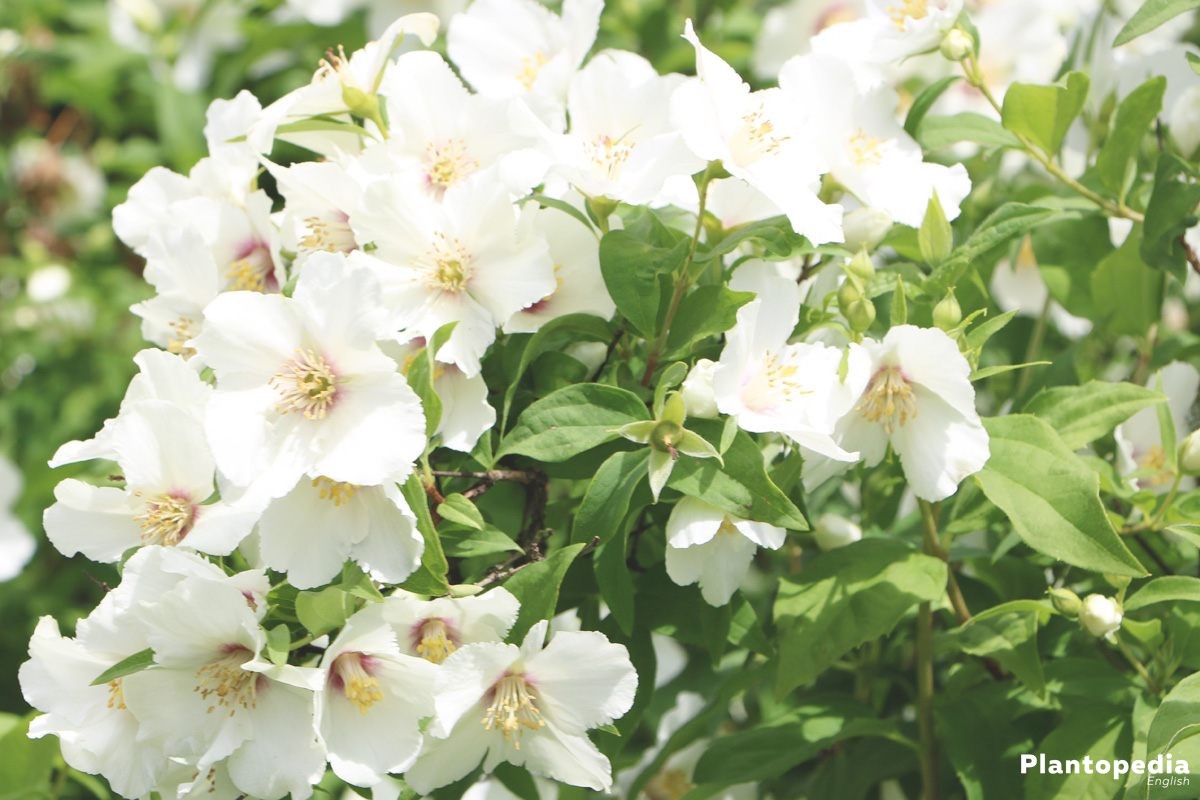
Mock Orange-Philadelphus

Mock-Orange Plant, Philadelphus Shrubs - Grow, Care & Pruning ...

Jane, as you know, mentioned lots of plants which she knew and loved, in her letters, and we have: “Laburnum rich, in streaming gold; Syringa Iv’ry pure” – she meant Philadelphus, or Mock Orange here.

Writing to her sister during the month of May [1811] she says: “The whole of the shrubbery border will soon be very gay with pinks and sweet-williams, in addition to the columbines already in bloom. The syringas (mock oranges), too, are coming out. . . . You cannot imagine – it is not in human nature to imagine – what a nice walk we have round the orchard. The rows of beech look very well indeed, and so does the young quickset hedge in the garden. I hear to-day that an apricot has been detected on one of the trees.” Was it a “Moor Park,” we wonder, such as Mrs. Norris and Dr. Grant quarrelled over?

Candytuft

Candytuft Plant: How To Grow Candytuft

Of the garden current vistors to Chawton will find, former curator Jean Bowden wrote in 1990,
“The garden at Jane Austen’s house is a joy to me… I am trying to grow plants which were introduced into England before Jane died in 1817, especially old shrub roses…I also sow old-fashioned annuals each year… like Love-in-the-Mist, Larkspur, cornflowers and Candytuft. Luckily, Columbines seed themselves all round the village – a nice very dark red one, almost black, and we also have some pink ones and pure white ones. Jane mentions Sweet Williams (Dianthus) and I grow these too, but they are more trouble as they are biennials and need replacing every other year.

Cornflowers-Bachelor's Buttons

Growing Annual Bachelor's Buttons (Centaurea cyanus)

Of the garden current vistors to Chawton will find, former curator Jean Bowden wrote in 1990,
“The garden at Jane Austen’s house is a joy to me… I am trying to grow plants which were introduced into England before Jane died in 1817, especially old shrub roses…I also sow old-fashioned annuals each year… like Love-in-the-Mist, Larkspur, cornflowers and Candytuft. Luckily, Columbines seed themselves all round the village – a nice very dark red one, almost black, and we also have some pink ones and pure white ones. Jane mentions Sweet Williams (Dianthus) and I grow these too, but they are more trouble as they are biennials and need replacing every other year.

Love-In-a-Mist

Of the garden current vistors to Chawton will find, former curator Jean Bowden wrote in 1990,
“The garden at Jane Austen’s house is a joy to me… I am trying to grow plants which were introduced into England before Jane died in 1817, especially old shrub roses…I also sow old-fashioned annuals each year… like Love-in-the-Mist, Larkspur, cornflowers and Candytuft. Luckily, Columbines seed themselves all round the village – a nice very dark red one, almost black, and we also have some pink ones and pure white ones. Jane mentions Sweet Williams (Dianthus) and I grow these too, but they are more trouble as they are biennials and need replacing every other year.

Sweetbriar Roses

Our garden is putting in order by a man who bears a remarkably good character, has a very fine complexion, and asks something less than the first. The shrubs which border the gravel walk, he says, are only sweetbriar and roses, and the latter of an indifferent sort; we mean to get a few of a better kind, therefore, and at my own particular desire he procures us some syringas. I could not do without a syringa, for the sake of Cowper’s line. We talk also of a laburnum. The border under the terrace wall is clearing away to receive currants and gooseberry bushes, and a spot is found very proper for raspberries.
Jane Austen to Cassandra
February 8, 1807

sweetbriar

 noun
sweet·​bri·​ar | \ ËˆswÄ“t-ËŒbrÄ«(-É™)r  \
variants: or sweetbrier

Definition of sweetbriar

an Old World rose (especially Rosa eleganteria) with stout recurved prickles and white to deep rosy-pink single flowers
 called also eglantine

Camellias

Camellias figured prominently in The Optimist's Daughter, as "Laurel's eye travelled among the urngs that marked the graves of the McKelvas and saw the favorite camellia of her father's, the old-fashioned Chandlerii Elegans, that he had planted on her mother's grave—big now as a pony, saddled with unplucked bloom living and dead, standing on a fading carpet of its own flowers."

Camellia japonicas bloom underneath Eudora’s bedroom window. Second shrub from left is the variety ‘Lady Clare’, a name she gave to a character in her novel Delta Wedding.


Eudora Welty on Gardening

Eudora and Chestina in the Garden


“I think that people have lost the working garden. We used to get down on our hands and knees. The absolute contact between hand and the earth, the intimacy of it, that is the instinct of a gardener. People like to classify, categorize, and that takes away from creativity. I think the artist – in every sense of the word – learns from what’s individual; that’s where the wonder expresses itself.”

Welty Garden

Thursday, April 23, 2020

Conch

And in the northwest corner there was a sun-dial of grey stone, placed just where the broad red walk that was bordered with striped grass, and picked out with pink conchs, ran71 off into Lofty John’s bush. Emily had never seen a sun-dial before and hung over it enraptured.
“Your great-great grandfather, Hugh Murray, had that brought out from the Old Country,” said Cousin Jimmy. “There isn’t as fine a one in the Maritime Provinces. And Uncle George Murray brought those conchs from the Indies. He was a sea-captain.”--emily of New Moon

Spirea

She wished the path might go on forever, but presently it veered away from the brook, and when she had scrambled over a mossy, old board fence she found herself in the “front-garden” of New Moon, where Cousin Jimmy was pruning some spirea bushes. --Emily of New Moon

Asters

“Cousin Jimmy is fixing up the garden. He lets me help him and I have a little flower bed of my own. I always run out first thing every morning to see how much the things have grown since yesterday. Spring is such a happyfying time isnt it, Father. The little Blue People are all out round the summer house. That is what Cousin Jimmy calls the violets and I think it is lovely. He has names like that for all the flowers. The roses are the Queens and the June lilies are the Snow Ladies and the tulips are the Gay Folk and the daffodils are the Golden Ones and the China Asters are My Pink Friends. --Emily of New Moon

Tulips

“Cousin Jimmy is fixing up the garden. He lets me help him and I have a little flower bed of my own. I always run out first thing every morning to see how much the things have grown since yesterday. Spring is such a happyfying time isnt it, Father. The little Blue People are all out round the summer house. That is what Cousin Jimmy calls the violets and I think it is lovely. He has names like that for all the flowers. The roses are the Queens and the June lilies are the Snow Ladies and the tulips are the Gay Folk and the daffodils are the Golden Ones and the China Asters are My Pink Friends. --Emily of New Moon

Tansy

The Tansy Patch was east of the Disappointed House, between the Blair Water and the sand-dunes. Most people considered it a bare, lonely, neglected place, but Emily thought it was fascinating. The little clap-boarded house topped a small hill, over which tansy grew in a hard, flaunting, aromatic luxuriance, rising steeply and abruptly from a main road. A straggling rail fence, almost smothered in wild rosebushes, bounded the domain, and a sagging, ill-used little gate gave ingress from the road. Stones were let into the side of the hill for steps up to the front door. Behind the house was a tumble-down little barn, and a field of flowering buckwheat, creamy green, sloping down to the Blair Water. In front was a crazy veranda around which a brilliant band of red poppies held up their enchanted cups. --Emily of New Moon

SPRING-Lucy Maud Montgomery

SPRING had come once more to Green Gables—the beautiful capricious, reluctant Canadian spring, lingering along through April and May in a succession of sweet, fresh, chilly days, with pink sunsets and miracles of resurrection and growth. The maples in Lover’s Lane were red budded and little curly ferns pushed up around the Dryad’s Bubble. Away up in the barrens, behind Mr. Silas Sloane’s place, the Mayflowers blossomed out, pink and white stars of sweetness under their brown leaves. All the school girls and boys had one golden afternoon gathering them, coming home in the clear, echoing twilight with arms and baskets full of flowery spoil. --Green Gables

Then, almost before anybody realized it, spring had come; out in Avonlea the Mayflowers were peeping pinkly out on the sere barrens where snow-wreaths lingered; and the “mist of green” was on the woods and in the valleys. But in Charlottetown harassed Queen’s students thought and talked only of examinations.--gg


Wednesday, April 22, 2020

Starflower

Starflowers will light up spring lawn | Louisiana Blooms

It was. Other people besides Anne thought so when they stumbled on it. It was a little narrow, twisting path, winding down over a long hill straight through Mr. Bell’s woods, where the light came down sifted through so many emerald screens that it was as flawless as the heart of a diamond. It was fringed in all its length with slim young birches, white stemmed and lissom boughed; ferns and starflowers and wild lilies-of-the-valley and scarlet tufts of pigeonberries grew thickly along it; and always there was a delightful spiciness in the air and music of bird calls and the murmur and laugh of wood winds in the trees overhead. Now and then you might see a rabbit skipping across the road if you were quiet—which, with Anne and Diana, happened about once in a blue moon. Down in the valley the path came out to the main road and then it was just up the spruce hill to the school.

Western starflower; Indian potato: Trientalis latifolia - Native ...

Starflower (Trientalis borealis Raf.)

By Larry Stritch
Starflower is a member of the Primrose family. The genus name Trientalis is from the Latin meaning “one third of a foot” which corresponds to the plant’s average height. The species name borealis refers to being from the north, although this plant is also distributed in the Midwest and the higher elevations of the southern Appalachian Mountains.
Starflower is a perennial herb that grows from slender, creeping rhizomes. Leaves are simple and occur in whorls of 5 to 9 at the tip of the stem. They are stalk less or on very short stalks and are entire to very finely-toothed. The flowers may occur as a single bloom or sometimes 2 to 3 blooms on slender stalks 3/4 to 2 inches long. Flowers are snow white with 5 to 9 petals and approximately 1/4 to 1/2 inch in diameter.
Starflower is one of the more common spring wildflowers in eastern North America, occurring in both deciduous and coniferous forests. Depending on latitude and elevation starflowers generally bloom from mid to late spring into early summer. Their habitat preference is open to dappled shade in moist woods but they may be found dry, sandy, acidic soils as well. Star flowers are pollinated by native bees. Starflower generally goes dormant in mid-summer with the leaves yellowing and then falling to the ground so that all that is left is the stem with 1 to 2 tiny seed capsules ripening at the tip. Seeds do not germinate before undergoing a cold stratification and do not germinate until the fall of the second year allowing seeds to be disseminated by insects. Starflowers will establish themselves in successional old fields that are adjacent to established colonies in old woods.
Many gardeners do not find starflower to be showy enough or to flower long enough for their tastes. However, if you are working in woodland shade garden it does add to the diversity of wildflowers in this type of naturalized planting. According to the New England Wildflower Society you should transplant from containers containing seed germinated plants in spring. Additionally, in late summer you can plant dormant rhizomes into an acid moist soil. These starts will easily spread around in a naturalized planting in a woodland garden. They require no maintenance once they are established. As always do not wild collect plants from public lands and only from private lands when the landowner grants permission. However, it is always best just to collect ripened seeds and not dig up rhizomes.


That bridge led Anne’s dancing feet up over a wooded hill beyond, where perpetual twilight reigned under the straight, thick-growing firs and spruces; the only flowers there were myriads of delicate “June bells,” those shyest and sweetest of woodland blooms, and a few pale, aerial starflowers, like the spirits of last year’s blossoms. Gossamers glimmered like threads of silver among the trees and the fir boughs and tassels seemed to utter friendly speech. --Green Gables

Musk Flower

Malva moschata f. alba - mallow white musk | Mallow flower, Plants ...

The Barry garden was a bowery wilderness of flowers which would have delighted Anne’s heart at any time less fraught with destiny. It was encircled by huge old willows and tall firs, beneath which flourished flowers that loved the shade. Prim, right-angled paths neatly bordered with clamshells, intersected it like moist red ribbons and in the beds between old-fashioned flowers ran riot. There were rosy bleeding-hearts and great splendid crimson peonies; white, fragrant narcissi and thorny, sweet Scotch roses; pink and blue and white columbines and lilac-tinted Bouncing Bets; clumps of southernwood and ribbon grass and mint; purple Adam-and-Eve, daffodils, and masses of sweet clover white with its delicate, fragrant, feathery sprays; scarlet lightning that shot its fiery lances over prim white musk-flowers; a garden it was where sunshine lingered and bees hummed, and winds, beguiled into loitering, purred and rustled. --Anne of Green Gables

Scarlet Lightening-Nonsuch

Outside in the garden, which was full of mellow sunset light streaming through the dark old firs to the west of it, stood Anne and Diana, gazing bashfully at each other over a clump of gorgeous tiger lilies.
The Barry garden was a bowery wilderness of flowers which would have delighted Anne’s heart at any time less fraught with destiny. It was encircled by huge old willows and tall firs, beneath which flourished flowers that loved the shade. Prim, right-angled paths neatly bordered with clamshells, intersected it like moist red ribbons and in the beds between old-fashioned flowers ran riot. There were rosy bleeding-hearts and great splendid crimson peonies; white, fragrant narcissi and thorny, sweet Scotch roses; pink and blue and white columbines and lilac-tinted Bouncing Bets; clumps of southernwood and ribbon grass and mint; purple Adam-and-Eve, daffodils, and masses of sweet clover white with its delicate, fragrant, feathery sprays; scarlet lightning that shot its fiery lances over prim white musk-flowers; a garden it was where sunshine lingered and bees hummed, and winds, beguiled into loitering, purred and rustled.
“Oh, Diana,” said Anne at last, clasping her hands and speaking almost in a whisper, “oh, do you think you can like me a little—enough to be my bosom friend?”
Diana laughed. Diana always laughed before she spoke. --Anne of Green Gables

Clover

Outside in the garden, which was full of mellow sunset light streaming through the dark old firs to the west of it, stood Anne and Diana, gazing bashfully at each other over a clump of gorgeous tiger lilies.
The Barry garden was a bowery wilderness of flowers which would have delighted Anne’s heart at any time less fraught with destiny. It was encircled by huge old willows and tall firs, beneath which flourished flowers that loved the shade. Prim, right-angled paths neatly bordered with clamshells, intersected it like moist red ribbons and in the beds between old-fashioned flowers ran riot. There were rosy bleeding-hearts and great splendid crimson peonies; white, fragrant narcissi and thorny, sweet Scotch roses; pink and blue and white columbines and lilac-tinted Bouncing Bets; clumps of southernwood and ribbon grass and mint; purple Adam-and-Eve, daffodils, and masses of sweet clover white with its delicate, fragrant, feathery sprays; scarlet lightning that shot its fiery lances over prim white musk-flowers; a garden it was where sunshine lingered and bees hummed, and winds, beguiled into loitering, purred and rustled.
“Oh, Diana,” said Anne at last, clasping her hands and speaking almost in a whisper, “oh, do you think you can like me a little—enough to be my bosom friend?”
Diana laughed. Diana always laughed before she spoke. --Anne of Green Gables

Orchid

Outside in the garden, which was full of mellow sunset light streaming through the dark old firs to the west of it, stood Anne and Diana, gazing bashfully at each other over a clump of gorgeous tiger lilies.
The Barry garden was a bowery wilderness of flowers which would have delighted Anne’s heart at any time less fraught with destiny. It was encircled by huge old willows and tall firs, beneath which flourished flowers that loved the shade. Prim, right-angled paths neatly bordered with clamshells, intersected it like moist red ribbons and in the beds between old-fashioned flowers ran riot. There were rosy bleeding-hearts and great splendid crimson peonies; white, fragrant narcissi and thorny, sweet Scotch roses; pink and blue and white columbines and lilac-tinted Bouncing Bets; clumps of southernwood and ribbon grass and mint; purple Adam-and-Eve (ORCHID), daffodils, and masses of sweet clover white with its delicate, fragrant, feathery sprays; scarlet lightning that shot its fiery lances over prim white musk-flowers; a garden it was where sunshine lingered and bees hummed, and winds, beguiled into loitering, purred and rustled.
“Oh, Diana,” said Anne at last, clasping her hands and speaking almost in a whisper, “oh, do you think you can like me a little—enough to be my bosom friend?”
Diana laughed. Diana always laughed before she spoke. --Anne of Green Gables

Soapwort-Bouncing Bet

Outside in the garden, which was full of mellow sunset light streaming through the dark old firs to the west of it, stood Anne and Diana, gazing bashfully at each other over a clump of gorgeous tiger lilies.
The Barry garden was a bowery wilderness of flowers which would have delighted Anne’s heart at any time less fraught with destiny. It was encircled by huge old willows and tall firs, beneath which flourished flowers that loved the shade. Prim, right-angled paths neatly bordered with clamshells, intersected it like moist red ribbons and in the beds between old-fashioned flowers ran riot. There were rosy bleeding-hearts and great splendid crimson peonies; white, fragrant narcissi and thorny, sweet Scotch roses; pink and blue and white columbines and lilac-tinted Bouncing Bets; clumps of southernwood and ribbon grass and mint; purple Adam-and-Eve, daffodils, and masses of sweet clover white with its delicate, fragrant, feathery sprays; scarlet lightning that shot its fiery lances over prim white musk-flowers; a garden it was where sunshine lingered and bees hummed, and winds, beguiled into loitering, purred and rustled.
“Oh, Diana,” said Anne at last, clasping her hands and speaking almost in a whisper, “oh, do you think you can like me a little—enough to be my bosom friend?”
Diana laughed. Diana always laughed before she spoke. --Anne of Green Gables

ROSES I Want

Sweet Briar Rose  Known as the "Sweet Briar Rose" because of the strongly apple-scented leaves, this is a favorite English na...